
I remember playing Mill in Grade School. It is not a game that you “buy”. You simply draw your own game board on a piece of paper or even in the sand at a beach. Just draw three squares, one inside another inside another. Then draw circles at the corners of all the squares. Then draw a line through the middle of each of the four sides to connect the squares to each other putting circles at the connection points. Voila. You have your game board:

Next … you need 9 markers for each of the two players. One could use pennies the other use nickels. Or one could use white poker chips and the other use red poker chips. Or use colored stones. Your choice :)
The game starts by alternating placing a marker on the board until all 18 markers have been placed. Then turns alternate moving a marker from one spot to another along a line.
Three of one players markers in a row or column is called a “mill” and is “safe” (ie, the opponent cannot take a marker that is part of a mill).
Below, the three white markers in a row form a Mill:
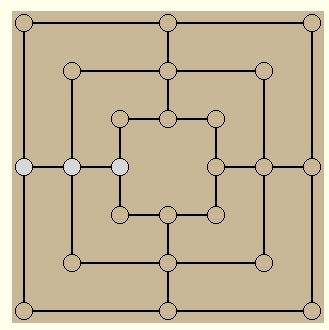
And next is an example of three dark markers in a column forming a Mill:

And that leads to the object of the game … to take your opponents markers (remove them from the board). The first person who has only two markers left loses.
Each time you move a piece that forms a Mill, you remove one of your opponents pieces from the board. On your next turn you can move one of those pieces away to a neighboring circle (thus ending that Mill). But the following turn you can move that piece BACK again, once more forming a Mill which means you can remove another of your opponents markers from the board.
When a player is down to just three markers they can “fly”… they can move one of their pieces to any blank spot on the board.
That’s all there is to it! Happy Milling!
PS: If you are interested in the history of this game, Wikipedia’s article about it dates it going back as far as 1400 BC!
 Play Heavenly Games
Leave a comment